The Hidden Reason Businesses Fail
Most entrepreneurs enter business with a dream: to make money, achieve freedom, and scale their impact. But here’s the painful truth — many of them don’t even know if they’re making money or losing it. They look at sales, celebrate revenue, and ignore the one metric that determines survival: profitability.
This is why thousands of businesses shut down each year. They think they’re successful because money flows in, but they ignore the expenses required to generate those sales. The reality? If you’re spending more to acquire a customer than you’re making from them, your business is a slow-motion train wreck.
One of the clearest lessons on this comes from Alex Hormozi’s playbook in his book $100M Offers. He simplifies success to a principle that every business owner must internalize: know exactly how much it costs to acquire a customer, and make sure you charge more than that.
It sounds obvious, but as you’ll see, most entrepreneurs completely ignore this truth.
The Principle from Alex Hormozi’s Playbook
Alex Hormozi doesn’t just speak theory. He scaled his gyms, built acquisition.com, and generated over $100 million by obsessing over a simple principle: unit economics.
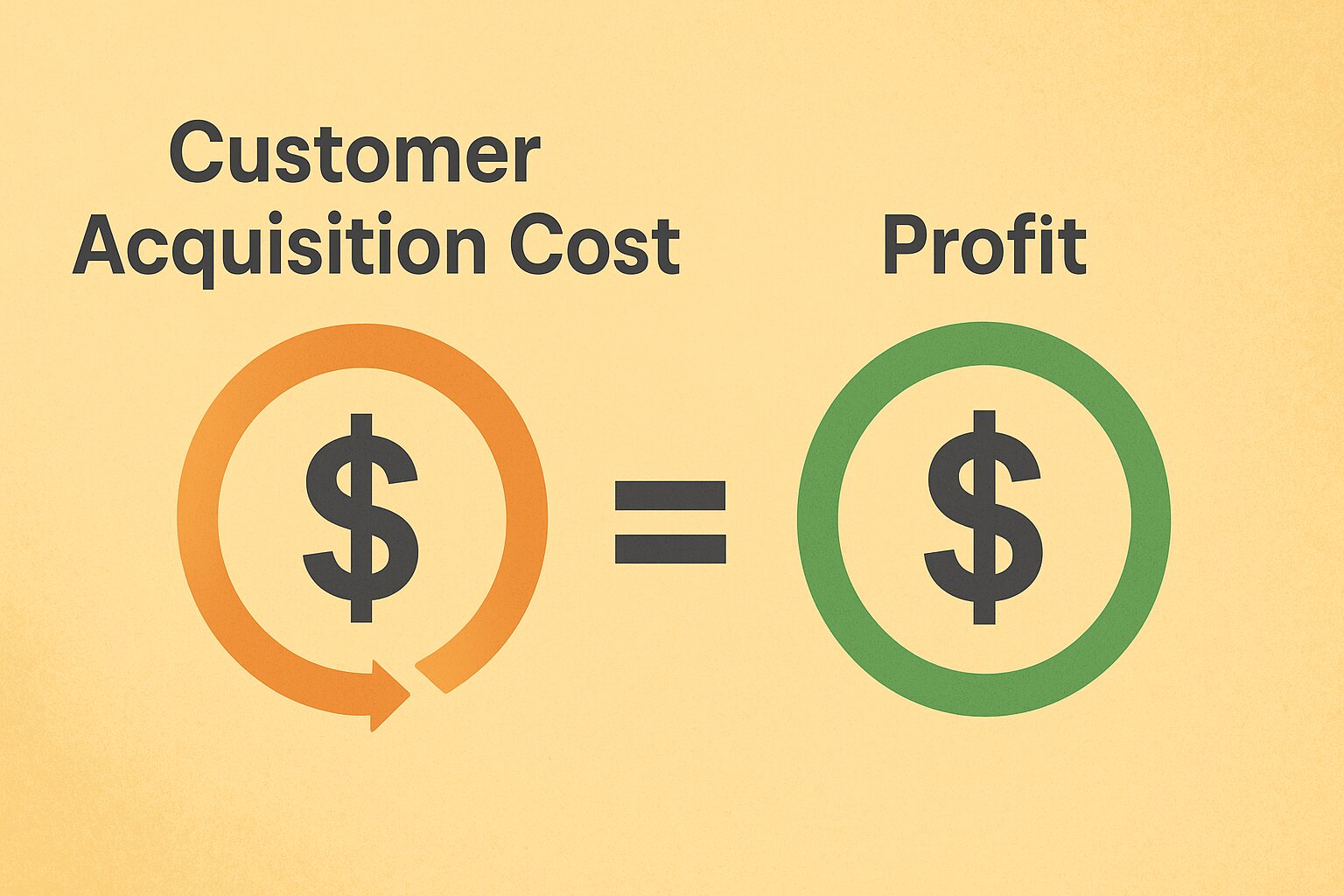
Unit economics is the study of the direct revenues and costs associated with a single unit of your product or service. In plain English: How much does it cost to acquire one customer, and how much do you earn from them?
If it costs you $100 to acquire a customer and you sell them a $50 product, you are in the red. If it costs you $120 and you sell them $500 worth of services, you are in the black. The game is about making that spread as wide as possible.
Hormozi emphasizes that most entrepreneurs don’t include hidden expenses. They’ll say, “My Facebook ad costs $100 to acquire a customer.” But what about the cost of tools like Calendly to schedule calls, Zoom to host meetings, and even the Shopify plugins to run your online store? Each of these increases your customer acquisition cost (CAC).
Ignoring these costs creates an illusion of profit. You might think you’re winning, but the numbers will eventually expose you.
https://youtube.com/shorts/gUhSXsdmv6s?si=-PhQRJy4WXIrYSs-
What Customer Acquisition Really Costs
Entrepreneurs love to simplify acquisition costs to ad spend alone. But in reality, CAC is far more complex. Here’s what you must factor in:
-
Ad Spend – Facebook, TikTok, YouTube, or Google Ads.
-
Software Tools – Calendly, Zoom, Shopify, plugins, email platforms.
-
Labor Costs – Sales reps, virtual assistants, or even your own time.
-
Creative Production – The time and money it takes to produce videos, designs, or copywriting.
-
Follow-Up Channels – Email automation, SMS tools, or CRMs.
Example:
-
Facebook Ads → $80
-
Calendly Subscription → $12
-
Zoom Pro → $15
-
Email Service → $13
Total CAC = $120
If that $120 customer only buys a $97 product, you’re negative. But if you convert them into a $500 coaching program, you’ve created profit.
A Real Example of Calculating Profitability
Let’s say you’re selling a high-ticket coaching program.
-
CAC = $120
-
Sales Price = $2,000
-
Profit = $1,880 before labor costs
Now imagine scaling this across 100 customers:
-
Acquisition Cost = $12,000
-
Revenue = $200,000
-
Profit = $188,000
That’s the power of knowing your numbers. You can confidently scale, because you know that every new customer creates more profit than expense.
But if you ignore the numbers and scale blindly, you may end up acquiring 100 customers at $120 each, selling them $100 each, and losing $2,000. Scale just makes you go broke faster.
Common Mistakes Entrepreneurs Make
Many businesses fail not because their idea was bad, but because they ignored simple math. Common mistakes include:
-
Ignoring Software Costs: Shopify plugins, Zoom licenses, and email tools all add up.
-
Confusing Revenue with Profit: $10,000 in sales means nothing if expenses are $12,000.
-
Over-Reliance on Ads: Spending without testing CAC vs. profit margins.
-
No Tracking: Guessing instead of using analytics to measure CAC and LTV (lifetime value).
In other words: they celebrate revenue while silently bleeding profit.
Related Article: Why Your Product Isn’t Selling: The Brutal Truth Most Entrepreneurs Ignore
The Role of Cost of Goods (COG)
COG, or Cost of Goods, is often misunderstood. For physical product businesses, it includes:
-
Manufacturing costs
-
Packaging
-
Shipping
-
Warehousing
If your t-shirt costs $7 to produce, $3 to ship, and $10 to acquire the customer via ads, your true cost is $20. If you sell it for $25, you only made $5 profit. And that’s before overhead.
For digital businesses, however, COG is almost zero. That’s why so many entrepreneurs shift to digital offers, coaching, and SaaS. Once you build the system, you can sell it infinite times at near-zero cost.
This is why moving into automation and digital offers is so powerful.
The Power of Automated Businesses
Automation reduces hidden costs, increases scalability, and boosts profit margins. When you set up an automated digital business:
-
You don’t buy inventory.
-
You don’t worry about shipping or storage.
-
You minimize customer service headaches.
Instead, you focus on creating a value-driven system that solves problems at scale.
This is the philosophy behind the I HATE 9-5 Mastermind, which shows how to build automated businesses without physical COG. By learning how to acquire customers almost for free and scaling with ads strategically, you flip the script on profitability.
Learn how to build your own automated multiple 7-figure business framework here: C2C Framework
How to Acquire Customers for Almost Free
Yes, you can acquire customers without spending a fortune. Here’s how:
-
Organic Social Media – Use TikTok, Instagram, or YouTube to create free content that attracts leads.
-
Referrals – Build referral systems to let existing customers bring in new ones.
-
Email Marketing – Build lists and nurture prospects until they’re ready to buy.
-
Partnerships – Collaborate with influencers or businesses in your niche.
When you combine free strategies with paid ads, your CAC decreases, and profit margins explode.
Paid Ads and Staying Profitable
Eventually, scaling requires ads. But here’s the golden rule: only scale ads when your numbers prove profitability.
-
Track your ROAS (Return on Ad Spend).
-
Test small budgets before scaling.
-
Kill campaigns that don’t profit.
Scaling without knowing your numbers is like pouring gasoline on a fire you don’t control.
The Importance of Mentorship in Scaling
Here’s the truth: you can waste years figuring this out on your own, or you can learn from someone who’s already done it.
Mentorship isn’t a luxury — it’s a shortcut to profit. A mentor saves you from costly mistakes, shows you proven systems, and keeps you accountable.
That’s why entrepreneurs who invest in coaching often leapfrog those who don’t.
Key Metrics Every Entrepreneur Must Track
If you want to ensure you’re always profitable, track these:
-
CAC (Customer Acquisition Cost) – What it costs to acquire each customer.
-
LTV (Lifetime Value) – How much a customer spends with you over their relationship.
-
COG (Cost of Goods) – Cost of products, shipping, or digital overhead.
-
Profit Margin % – The percentage of revenue left after expenses.
Ignoring these metrics is like driving a car blindfolded.
Turning Numbers Into Strategy
Once you know your numbers, you can:
-
Adjust Pricing – Charge more than your CAC.
-
Use Upsells & Cross-Sells – Sell more to existing customers.
-
Bundle Offers – Increase value per transaction.
-
Improve Retention – Extend customer lifetime value.
This turns your business from a gamble into a predictable money machine.
Frequently Asked Questions
What is customer acquisition cost (CAC)?
It’s the total cost of acquiring one customer, including ads, tools, and labor.
Why is CAC important?
If CAC exceeds your profit per customer, your business loses money.
What is cost of goods (COG)?
The cost of producing and delivering your product or service.
Can digital businesses really have zero COG?
They often have near-zero COG compared to physical products, which is why they’re so profitable.
How do I lower CAC?
Use organic marketing, referrals, and content to attract customers before relying heavily on ads.
Should I hire a mentor?
Yes — mentorship saves time, prevents costly mistakes, and helps scale profitably.